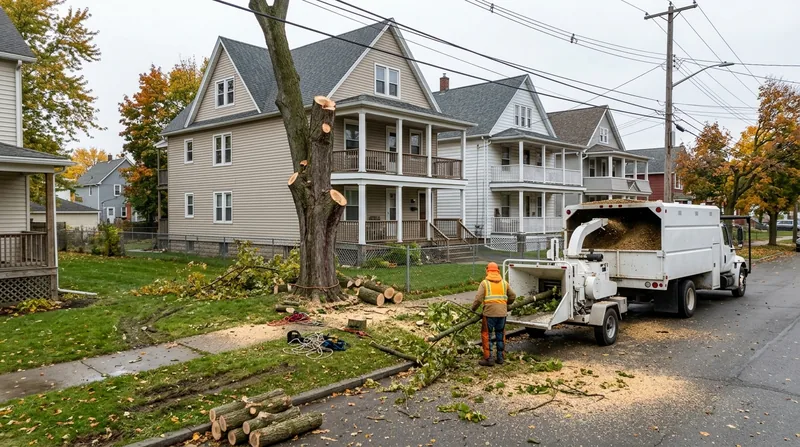




Tree removal in Buffalo requires more than a chainsaw and a truck. Our region's dense residential neighborhoods, aging two-story wood-frame doubles with narrow lots, overhead utility lines, and proximity to fences and garages demand precision work every time. Buffalo's canopy is dominated by Norway maple, silver maple, sugar maple, and red oak, many of them mature and heavy, especially along the tree lawns between sidewalk and curb. When a tree dies, leans toward a structure, or simply needs to come down, the stakes are high. Buffalo Tree Service removes hazardous, dead, and unwanted trees of any size with full rigging, equipment access, and the expertise to work safely in tight spaces. We serve Buffalo and surrounding areas including Amherst, Tonawanda, Cheektowaga, and Orchard Park. Call us at (716) 710-8792 for a free estimate, or learn more about our emergency tree service for storm damage and hazard situations.
Why Tree Removal Matters in Buffalo's Tight Residential Lots
Buffalo's housing stock defines the challenge. Whether you own a Victorian in Allentown, a post-war cape in Cheektowaga, or a colonial in Amherst, your lot is likely narrow with a shared driveway, rear garage, and neighbors close on both sides. A mature maple or oak that was planted 50 years ago can now overhang your roof, block gutters, drop limbs onto power lines, or crack a foundation. Snow-belt winters load heavy wet snow onto those steep gable roofs, and weak or diseased trees fail first. Dead ash trees, in particular, dot our landscape, left standing after disease swept through. Removing these trees before they fail protects your home, eliminates liability, and opens up space and light.
- We assess tree health and structural integrity before recommending removal versus trimming.
- We coordinate with utility companies when power lines cross the work zone to ensure safe de-energizing.
- We handle permit applications for protected trees in Buffalo and neighboring cities where local ordinances apply.
- We rig large removals with cranes or bucket trucks to lower sections safely into tight spaces without striking structures.
- We haul debris and chip brush on-site, leaving your property clean and ready for the next phase.
Proper tree removal prevents damage to homes, fences, and utilities that a DIY approach or an unlicensed operator would almost certainly cause.
Key info: Buffalo and surrounding municipalities require removal permits for trees above a set diameter or DBH (diameter at breast height). Heritage tree ordinances protect certain species like oak and specific urban trees. Check your city's zoning office or ask us during your estimate. We handle all permit paperwork.
For more detail on local regulations, visit the City of Buffalo Department of Permit and Inspection Services website for current tree protection rules.
How We Remove Trees Safely in Buffalo Neighborhoods
Every removal in Buffalo is different because every lot is different. A tree 30 feet from your neighbor's fence requires a different plan than one 10 feet from power lines or touching your roof. We start with a site visit, assess the tree's lean, root condition, and the obstacles around it, then choose the safest and most efficient method. For large trees on confined lots, we use cranes or bucket trucks to lower sections piece by piece. For accessible trees, we rig and lower limbs by rope. We never drop a large section free into a residential lot.
- We conduct a free on-site inspection and discuss the removal plan before we commit to a price.
- We clear the work zone and brief you on timing, equipment, and what to expect.
- We cut the tree in sections, lowering or rigging each piece to the ground safely.
- We remove the stump by grinding it below grade or extracting the root ball if you prefer replanting space.
- We haul all debris off-site or chip it for mulch, and sweep the area clean before we leave.
This methodical approach takes longer than a reckless drop, but it protects your property and your neighbors' property.
Local example: A homeowner in Tonawanda had a 60-foot sugar maple leaning over the garage and power lines. We rigged it with a bucket truck, lowered it in sections, and removed the stump in one day. The work required coordination with the utility company and a permit. Total time on-site: six hours. No damage to the garage, fence, or neighboring property.
If your tree needs removal and you're not sure about stump grinding, read more about stump grinding options to decide what's right for your space.
Tree Removal Methods: Which Approach Works for Your Situation
| Approach | Description | Best for |
|---|---|---|
| Bucket Truck Removal | Aerial lift positions the operator at the crown to cut sections and lower them by rope to the ground. | Medium to large trees near power lines, roofs, or fences with street access for the truck. |
| Crane Removal | Heavy equipment lifts large sections and lowers them to a staging area or directly to a truck. | Very large trees, confined lots, or jobs where rigging by rope alone is unsafe or impractical. |
| Rigging and Lowering | Climber cuts sections at height while ground crew manages ropes and guides each piece safely down. | Accessible trees on open lots, or where equipment access is limited but the tree is tall and must be sectioned. |
| Directional Felling | Tree is cut at the base and guided to fall in a predetermined direction, then bucked into sections on the ground. | Trees on large, open properties with clear fall zones and no structures or utilities in the path. |
We choose the method based on tree size, location, soil conditions, and obstacles. During your free estimate, we'll explain which approach is safest and most cost-effective for your job.
Tree Removal Cost in Buffalo: What to Expect
Tree removal pricing in Buffalo depends on multiple factors, and there is no one-size-fits-all number. A small 20-foot tree on an open lot costs far less than a 70-foot oak with power lines overhead and a garage underneath. We provide a free estimate after an on-site inspection so you see exactly what you're paying for. Many homeowners get two or three estimates to compare price and approach, which is smart practice. The cheapest bid is not always the safest or the best value.
The main cost drivers are tree height and diameter, proximity to structures and utilities, access for equipment, soil and root conditions, and whether stump grinding is included. A tree in the 30-to-50-foot range on a residential lot typically runs $1,200 to $3,500 depending on these factors. Very large trees, those near power lines, or jobs requiring crane work will cost more. Small trees under 25 feet often run $400 to $1,000. Emergency removal after a storm or for a hazardous tree may cost more due to scheduling and urgency.
We also charge separately for stump grinding if you want the root removed, though many customers do this at the same time as the tree removal for a package price. Debris removal and cleanup are included in our estimate. Travel costs within Buffalo and surrounding areas are included in the estimate with no separate mileage fee.
The best way to understand cost is to call us at (716) 710-8792 and describe your tree and situation. We'll schedule a free on-site estimate within 24 hours. No obligation to book. For a detailed breakdown of pricing by job type, visit our pricing page.
What to Look for When Hiring a Tree Removal Service Near Me in Buffalo
Finding the right contractor matters as much as the price. Buffalo has many tree services, but not all carry the right licenses, insurance, and local knowledge. Before you hire, ask the right questions and verify credentials. A fully insured company protects you from liability if something goes wrong. A contractor who understands Buffalo's permit requirements and heritage tree ordinances will keep you out of trouble with the city. References from recent jobs tell you whether the company shows up on time, does clean work, and treats your property with respect.
- Verify the contractor holds any license your town or county requires and shows proof of general liability and workers compensation insurance.
- Ask for at least three references from recent tree removal jobs in Buffalo or your neighborhood, and call them.
- Confirm the contractor understands local permit requirements and will handle applications if needed for protected or heritage trees.
- Check whether your HOA requires approval for visible tree removal, and ask the contractor if they have experience navigating HOA rules in your community.
- Get written estimates from two or three contractors that detail the scope, method, timeline, cleanup, and total cost.
- Never hire based on price alone, especially for tree work, where a low bid often signals inexperience or corner-cutting.
A reputable contractor will answer your questions, provide clear estimates, and stand behind their work. If a contractor pressures you to decide immediately or refuses to put the estimate in writing, move on.
Ready to get started? Contact Buffalo Tree Service for a free estimate. We're insured, and familiar with every neighborhood in Buffalo and the surrounding towns.
Tree Removal in Buffalo: Pricing Guide
| Service | Price | Details |
|---|---|---|
| Small tree removal | Starting at $400 | Trees under 25 feet, open access, no utilities or structures nearby, includes debris removal |
| Medium tree removal | Starting at $1,200 | Trees 25 to 50 feet, residential lot, bucket truck or rigging, proximity to structures or utilities |
| Large or complex removal | Starting at $3,500 | Trees over 50 feet, crane work, power line coordination, confined lot, multiple obstacles or hazards |
| Stump grinding | Starting at $200 | Grinding stump below grade, small to large stumps, included or separate depending on removal package |
| Free estimate | No charge | On-site inspection, written quote, response within 24 hours, no obligation to book, call (716) 710-8792 |
Indicative pricing, the exact cost depends on square footage, finish, and site access. Free personalized estimate within 24h at (716) 710-8792.


