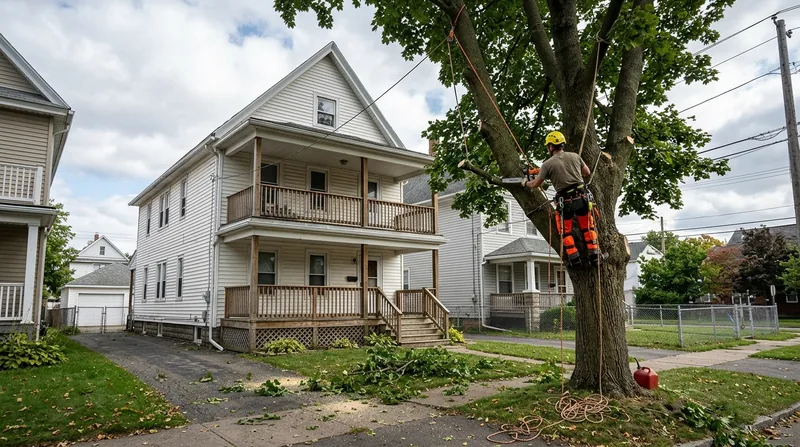




Buffalo's dense residential neighborhoods, from the Victorian doubles of Allentown to the post-war colonials of Amherst and the aluminum-sided ranches of Cheektowaga, depend on mature tree canopies for shade, privacy, and windbreak protection. Norway maples, sugar maples, honeylocusts, and red oaks tower over narrow lot lines and shared driveways, but heavy snow loads, ice storms, and the region's lake-effect weather create constant structural stress. Tree trimming and pruning in Buffalo is not cosmetic work, it is structural maintenance that prevents branch failure over roofs, gutters, service drops, and parked cars. We remove deadwood, thin crowns to reduce wind and snow load capture, and clear sight lines to utilities and structures before ice and weather do the damage for you.
Why Professional Tree Trimming Matters in Buffalo's Heavy Snow and Ice Climate
Buffalo receives an average of 95 inches of snow per year, and ice storms deposit thick coatings that add hundreds of pounds to branch systems evolved for temperate climates. Norway maples and silver maples, which dominate Buffalo's street and yard canopies, have brittle wood and dense branching that traps snow and ice like a net. Unpruned branches fail over driveways, snap into power lines, or collapse onto the steep gable roofs common to Buffalo doubles and colonial homes. Professional pruning removes the weak forks, crossing branches, and dead limbs that snap first under load, and thins the crown to let wind and snow pass through rather than pile up on the branch structure.
- We remove deadwood and diseased limbs that fracture under snow and ice loads before they fall.
- Crown thinning reduces wind and snow resistance so branches flex and shed load rather than snap.
- We clear branches over roofs, gutters, and driveways to prevent damage to structures and vehicles.
- Pruning improves air circulation and light penetration to reduce fungal disease and ice dam risk.
- We identify and remove co-dominant stems and weak branch angles before they fail catastrophically.
Proper pruning extends the life of your trees and protects your home, driveway, and utility lines from the ice and snow damage that defines Buffalo winters.
Key info: Buffalo homeowners in Amherst, Cheektowaga, and West Seneca often wait until after an ice storm to call for cleanup, but the real value is in preventive pruning done in late fall or late winter to remove the branches that will fail under load. A single mature Norway maple over a roof can drop 200 pounds of ice-laden branches in a single storm. Pruning now prevents that disaster.
For more information on managing tree risk during harsh weather, visit the New York State Department of Environmental Conservation Forest Health page, which covers storm damage prevention and tree maintenance in cold climates.
How We Approach Tree Trimming and Pruning in Buffalo: Our Process
We start with an on-site assessment to identify the tree species, structural defects, and risk points. A Norway maple over a roof in Buffalo needs different pruning than a honeylocust in a side yard or a red oak on a property line. We evaluate branch angles, codominant stems, deadwood, and proximity to power lines, then develop a pruning plan that improves health and structure while respecting the tree's form and your property layout.
- We inspect the entire canopy for deadwood, disease, and structural weakness before making any cuts.
- We identify and prune weak branch crotches and crossing limbs that will fail under snow or wind stress.
- We thin the crown systematically to reduce weight and wind resistance without stripping the tree bare.
- We clear branches away from roofs, gutters, service drops, and driveway clearance zones as needed.
- We remove all brush and debris from your property, leaving the site clean and ready for the next snow or season.
The result is a structurally sound tree that sheds snow and ice rather than trapping it, and a yard free from the branch fall and debris that ice storms leave behind.
Local example: A homeowner in Kenmore had a 60-foot Norway maple hanging over the roof of a 1920s bungalow. The tree had multiple dead limbs, a weak crotch at 25 feet, and dense crown that collected ice. We removed the deadwood, pruned the weak crotch, and thinned the crown by 20 percent. The next winter ice storm that knocked down trees around the neighborhood left that maple standing strong and shedding load safely.
If your trees need structural work or you are concerned about winter damage, call us at (716) 710-8792 for a free estimate. We also offer arborist consultation if you want a detailed assessment of tree health and long-term management.
Pruning Methods and Techniques for Buffalo Trees
| Approach | Description | Best for |
|---|---|---|
| Deadwood Removal | Complete removal of dead, diseased, or dying branches back to the branch collar or main stem. | All tree species; improves health and removes hazard branches that snap under ice load. |
| Crown Thinning | Selective removal of interior branches to reduce crown density, improve light penetration, and reduce wind and snow resistance. | Norway maples, silver maples, honeylocusts, and other dense species that trap ice and snow in Buffalo. |
| Structural Pruning | Removal of codominant stems, weak branch angles, and crossing branches to establish a single main leader and strong branch structure. | Younger trees and trees with multiple leaders; prevents future branch failure and improves tree longevity. |
| Clearance Trimming | Removal of branches that overhang roofs, gutters, driveways, service drops, and utility lines to prevent damage and maintain safe clearance. | Trees near structures in tight residential lots common to Buffalo, Amherst, Cheektowaga, and suburban areas. |
| Crotch Removal | Pruning of weak branch angles and codominant stems to remove the branch with the poorest attachment angle and leave a strong primary structure. | High-value trees and trees over structures; prevents catastrophic failure of the weak branch under snow or wind load. |
Tree Trimming and Pruning Cost in Buffalo: What to Expect
Professional tree trimming in Buffalo starts at $250 for small trees or selective deadwood removal, and increases based on tree size, height, access, species, and proximity to structures. A 40-foot Norway maple over a roof in a narrow Allentown lot requires more time and equipment than a 25-foot crabapple in an open Orchard Park yard. Access also matters: trees on steep terrain in West Seneca or near power lines and utility easements require additional safety precautions and planning. Most homeowners spend $300 to $800 for a single mature tree, and $1,200 to $3,000 for multiple trees or larger properties. Our full pricing overview provides more detail on specific job types and factors that influence cost.
We recommend getting 2 to 3 estimates from insured contractors before deciding. Estimates should include the scope of work (deadwood removal, crown thinning, clearance trimming), tree species and height, access challenges, and debris removal. A contractor who walks your property and takes time to assess your trees will give you a more accurate quote than one who estimates over the phone. Call us at (716) 710-8792 for a free estimate with no obligation to book.
Tree Trimming and Pruning Near Me: What Buffalo Homeowners Should Know Before Hiring
Start by confirming that any contractor you hire is insured and holds any license your town or county requires. Ask for proof of general liability and workers compensation insurance, and verify that they carry coverage for tree work specifically. Many Buffalo neighborhoods, especially in Amherst, Orchard Park, and along Delaware Avenue, have homeowners associations or historic district guidelines that require approval before visible tree work. Check your deed or HOA rules before scheduling pruning, and ask your contractor if they are familiar with local permitting and heritage tree ordinances. Some cities in the Buffalo area require permits for tree removal or pruning of protected species or trees above a certain diameter, so clarify this upfront.
- Verify fully insured status with proof of general liability and workers compensation insurance before any work begins.
- Ask for references from recent jobs in Buffalo, Tonawanda, Cheektowaga, or Amherst, and call them to ask about quality and cleanup.
- Get written estimates that describe the scope of work, tree species, height, and debris removal so you can compare fairly.
- Check HOA rules and local ordinances for your neighborhood before approving pruning, especially in historic districts or protected tree zones.
- Ask if permits are required for your tree species or size, and whether the contractor will handle permitting or coordinate with the city.
- Confirm that all brush and debris will be removed from your property and disposed of properly after the job is complete.
A reputable contractor will answer these questions clearly and help you navigate local rules so your pruning work is done right and stays within Buffalo's regulations. Contact us to schedule a free estimate and discuss your tree care needs with our team.
Tree Trimming & Pruning in Buffalo: Pricing Guide
| Service | Price | Details |
|---|---|---|
| Small tree trimming | Starting at $250 | Deadwood removal and selective pruning on trees under 35 feet, single limb clearance work |
| Medium tree crown thinning | Starting at $450 | Full crown thinning on 35 to 50-foot maples or oaks to reduce snow and ice load capture |
| Large tree structural pruning | Starting at $700 | Crotch removal, codominant stem pruning, and structural work on 50+ foot trees near structures |
| Multiple trees or complex site | On estimate | Tight residential lots, power line clearance, or jobs requiring crane or bucket truck access need on-site assessment |
| Travel and setup | Included | No separate mileage or travel fee for Buffalo and surrounding service areas within 20 miles |
| Free estimate | No obligation | On-site walk-through and written quote within 24 hours at (716) 710-8792, no deposit required |
Indicative pricing, the exact cost depends on square footage, finish, and site access. Free personalized estimate within 24h at (716) 710-8792.


